
Minakshi Aggregate Industries, located in Sripur village of Kalaiya Sub-Metropolitan City-24, Bara, which the Supreme Court ordered to shut down, is preparing to resume operations. Meanwhile, the village schoolteacher who won the case in the Supreme Court is being continuously harassed by the police and the crusher entrepreneur.
Sripur village in Kalaiya Sub-Metropolitan City-24, Bara, is home to 200 families. Right in the middle of this village sits Minakshi Aggregate Industries, a crusher industry engaged in the production and trade of gravel and stone. The industry was established in 2007 by Brij Kishore Prasad Kalwar without obtaining any of the required permits.
Residents had been demanding the closure of the crusher, citing direct health impacts caused by the industry, including eye diseases, tuberculosis, respiratory illnesses, asthma, high blood pressure, skin irritation and ear problems among the villagers. However, their demands were ignored everywhere.
Thereafter, the villagers moved the Supreme Court on April 25, 2025. The effort was led by Mina Chaudhary (35), the headteacher of Nepal Rastriya Basic School located near the crusher industry. Sripur, where Mina resides, is a settlement of the Chamar community, where most residents earn a living through daily wage labor. Mina is one of the women who stands at the forefront to help whenever a problem arises in the village.
Following the demand of Mina and fellow villagers, the Supreme Court issued a mandamus order on August 21, 2025, against the crusher. The order states: "...Since effective regulation and control of industries and businesses within their jurisdiction is not seen to have been carried out, execute and cause to execute the report sent for necessary action via letter dated May 20, 2025 from the District Coordination Committee Office, Kalaiya, Bara..."
The District Coordination Committee report cited by the Supreme Court in its order reads:
"...Since Minakshi Aggregate Industries is operating without fulfilling the distance standards under S.N. 1, 3, and 7 of Sub-section (1) of Clause 11 of the criteria, the concerned municipality must have an environmental study conducted for the said crusher industry and cause it to be relocated by mid-July 2023. In the case of an industry that refuses to relocate, the concerned municipality shall recommend to the relevant authority for the cancellation of its registration..."
However, the entrepreneurs have not complied with the Supreme Court’s order. Instead of shutting down and relocating the crusher, they are preparing to resume operations at the very same site in defiance of the court ruling. To facilitate this, they have been exerting continuous pressure on Mina, the village schoolteacher who led the court case. The villagers also allege that the police are aiding the industrialist.
Mina says that the industrialist filed baseless complaints against them, and relying on those very complaints, the police have been repeatedly summoning them to the station. “I initially thought of avoiding any litigation, fearing this kind of trouble,” she says. “However, when staying in the village became unbearable, I filed the suit and won. Yet, the crusher operators still haven’t stopped threatening us.”
After winning the case against the crusher industry, Mina feels that her very right to live peacefully has been stripped away. She can no longer stay at home alone. Whenever she must, she locks the door from the inside. She lives in constant fear even while teaching at school and startles at the sight of crusher tipper trucks on the road. According to Mina, blaming her for the shutdown of the crusher, the industry’s side has long been threatening to run her over with tippers, coming to her home to assault her and instilling fear.
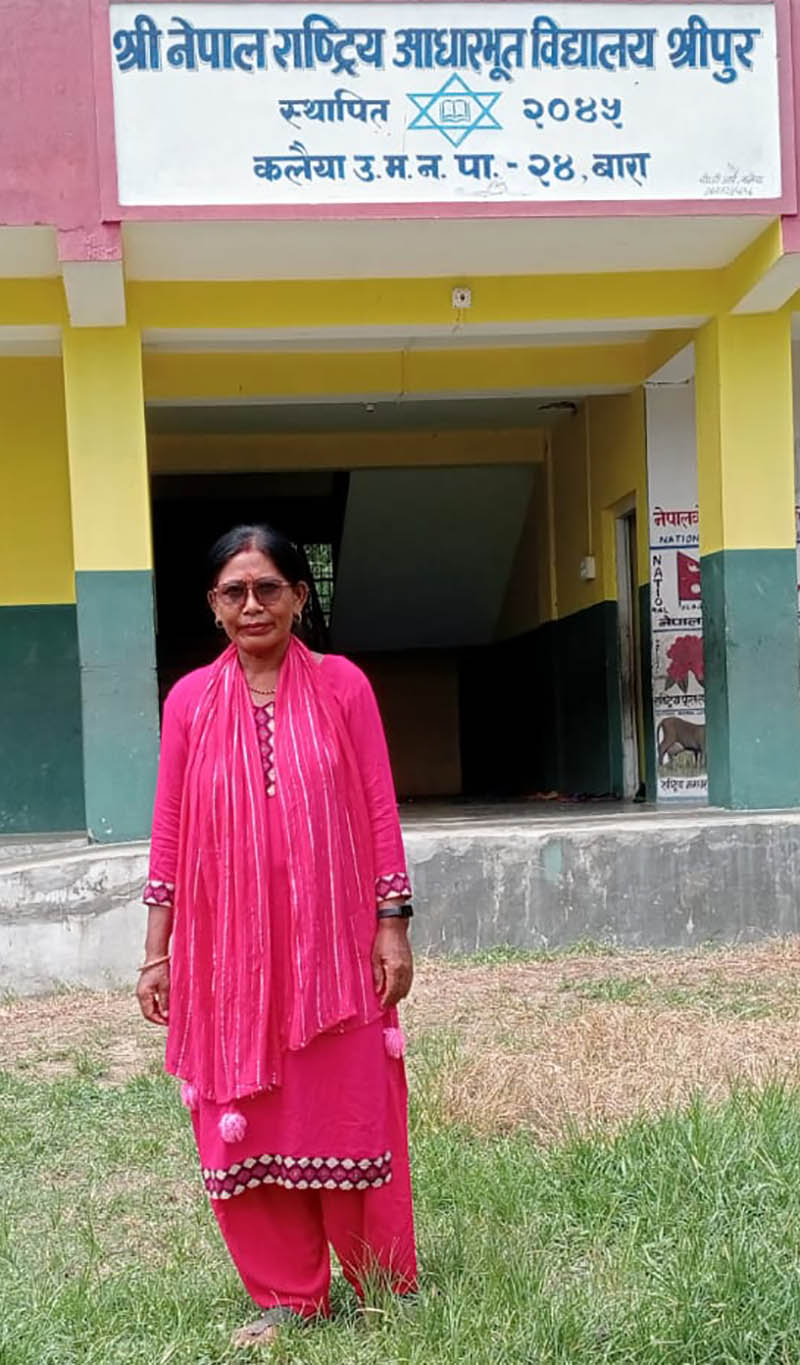
“The industry manager repeatedly says, ‘The crusher was shut down because of you.’ I am constantly terrified that they might return and attack me,” she says.
Bhanturam (66), whose house is near the crusher, shares that the industry side has not stopped harassing them even after winning the case. “We have nowhere else to go except this place, and it’s just my wife and me living here,” he says. “Even after winning the lawsuit, they have caused us endless trouble by filing counter-complaints with the police against us.”
He expresses deep worry that the crusher entrepreneurs are trying to restart the industry using money power, recalling how his house used to shake whenever the crusher operated.
Refusing to implement the Supreme Court’s order, harassing those who won the case
In August, the Supreme Court issued a mandamus order to implement the report of the District Coordination Committee, Bara. The report was based on a field study conducted by the ‘Riverbed and Mining Materials District Monitoring Committee’ formed on May 4, 2025. The study report concluded that the distance criteria prescribed for operating a crusher industry under the Standards for Extraction, Sale, and Management of Stone, Gravel, and Sand, 2020 had not been met. Specifically, it determined that the distance standards set out under Clause 11, Sub-clause 1, Items 1, 3, and 7 of the 2020 Standards were not observed.
These sub-clauses mandate that a crusher industry must be located more than 500 meters away from highways, and at least two kilometers away from educational institutions, health facilities, sites of religious, cultural and archaeological importance, security agencies and dense settlements. However, the study report noted that Minakshi Aggregate Industries is situated within 500 meters of the highway and less than two kilometers from educational institutions, religious and cultural areas, and dense settlements.
Additionally, Sub-clause 9 of Clause 11 stipulates that for older crusher industries operating without meeting the distance requirements, the concerned rural municipality or municipality must have an environmental study conducted and cause the industry to be relocated within one year. It further states that if an industry refuses to relocate, a recommendation must be submitted to the concerned authority for the cancellation of its registration.
Based on these grounds, implementing the Supreme Court’s order requires shutting down the crusher in the middle of the settlement and relocating it elsewhere. The District Administration Office, Bara, even wrote to the District Police Office, Bara, on November 17, 2025, to execute the court order. Yet, despite that order, the crusher industry has neither been relocated nor has the security of Mina and the villagers who won the case been guaranteed.
Mina states that instead of executing the Supreme Court’s order, the police are harassing them. She mentioned that in the last month-and-a-half alone, the police came to her school and home, summoning her to the police station 10 times.
On July 22, Mina, her family and 30 villagers were summoned to the District Police Office. They had no clear information as to why they were called. “We went because the police came to our house and said they would take us in a van if we didn’t show up,” Mina said. “However, when we got there and asked for the reason, we were told that the complaint paper itself had been lost.”
Earlier, on June 19, 2026, the Jaitapura[a1] Police Post had issued a letter asking eight people, including Mina, to present themselves. Mina states that all of this is happening with the intent to harass them.
However, Police Inspector Huma Nand Khanal of the District Police Office, Bara, stated that they were summoned.
for questioning following a complaint alleging ‘obstruction, threats and intimidation regarding the operation of the crusher.’ When asked about complaints that the police were harassing residents instead of executing the Supreme Court’s mandamus order to shut down the crusher industry, he said, “The crusher operators lodged the complaint. We have sent it to the investigation branch. We don’t know what kind of order exists against the crusher, but we will look into that as well. However, when the police call, one cannot say they will not present themselves at the office.”
Mina had also filed a complaint with the Ministry of Home Affairs on July 1 seeking peace and security. “After filing the complaint, the police didn’t come for a few weeks. Whether it was due to the Home Ministry complaint or because it was time for his transfer, Police Assistant Inspector Rasindra Yadav, who issued the letter, was transferred. However, the new Police Assistant Inspector who replaced him has started causing us the same trouble all over again,” Mina says.
Meanwhile, Police Assistant Inspector Parashuram Sah of the Jaitapur Police Post stated that Mina Chaudhary and others were summoned under the direction of the District Police Office, Bara. “However, the Superintendent of Police has instructed us to hold that letter for now,” he said. “They were called only for routine questioning and all procedures have currently been paused.”
Contempt of court
In fact, even before Mina initiated her legal battle against the crusher industry, the government had already taken action against it. On January 4, 2023, the Ministry of Home Affairs instructed authorities to disconnect the electricity supply to 15 crusher industries across the country operating illegally, including those that were unrenewed, operating in violation of standards, or submitting outdated environmental assessment reports. In line with this directive, power to Minakshi Aggregate Industries, which was listed among them, was also cut off.
Minakshi Aggregate Industries faced action for operating without renewal, lacking raw material storage space, and failing to construct the required access roads for transportation, among other reasons. However, after crusher entrepreneurs nationwide launched protests, the government backed down from its decision within just a month. Consequently, most illegally operating crusher industries resumed operations. When Minakshi Aggregate Industries also reopened, forcing villagers to live amidst dust and smoke once again, the residents moved the Supreme Court seeking justice.
However, nearly a year after the Supreme Court’s order, pressure is being exerted on the petitioners through the police instead of implementing the decision, which Advocate Padam Bahadur Shrestha describes as contempt of court. Shrestha, an expert in environmental law, had argued in the Supreme Court on behalf of Mina and the villagers.
“It appears the crusher operators are using the local police without informing them about the Supreme Court order against them, acting solely with the intent to harass the petitioners. Since this is a serious matter, necessary action must be taken,” said Advocate Padam Bahadur.
According to Senior Advocate Chandra Kanta Gyawali, filing police complaints targeting the winning party even after a Supreme Court mandamus order constitutes defiance of the court ruling. “In such a situation, the writ petitioner can file a contempt of court case against the opposing party,” he says. “Once a mandamus order is issued, the verdict is known to the opposing party as well. They cannot claim ‘we didn’t know.’ Once the court issues an order, it is no longer a personal matter. It becomes a state decision that must be complied with.”

In 2020, Dilip Mahato of Dhanusha was crushed to death by a tipper truck simply for speaking out against local crusher entrepreneurs. The perpetrators of that incident are currently in prison. Even since then, those raising their voices against crusher industries or the exploitation of the Chure region at the local level continue to face threats and physical assaults. Remembering these incidents, Mina cannot gather the courage to step outside her house.
“Remembering the crusher’s tipper trucks and aggressive drivers, I don’t even dare to go outside.” She asks, “How long do I have to suffer such pain? When will I get peace?”
Advocate Dilraj Khanal points out that due to the lack of specific laws in Nepal to ensure the safety of environmental defenders, people like Mina who speak up for environmental protection remain at risk. According to him, the state’s security apparatus prioritizing the interests of industrialists and investors over citizens advocating for environmental conservation is also responsible for the rise in such incidents.
“On one hand, there is no explicit law to protect environmental activists, and on the other, their security depends on the state’s own security machinery,” Advocate Dilraj says. “The security mechanism lacks a sensitive approach toward environmental activists, which is why even the basic human rights of those speaking out on environmental conservation issues remain unprotected.”
Defiant operator
Munna Ojha, the manager of Minakshi Aggregate Industries, refuses to accept that they threatened the villagers or harassed them by filing baseless complaints with the police administration. Instead, he accuses Mina and her family of threatening and verbally abusing them every day.
“They have been stopping my crusher using wooden sticks and clubs since 2007,” he says. “If it is stopped through legal means, I will halt operations. However, an individual cannot simply shut it down.” When reminded that the Supreme Court has already ruled the crusher industry to be operating against the standards and issued a mandamus order to shut it down, he maintains that an industry cannot be closed just because an individual files a lawsuit.
According to Mohan Bahadur Chhetri, spokesperson for Kalaiya Sub-Metropolitan City, operating Minakshi Aggregate Industries in the middle of a settlement is completely wrong. “Furthermore, the Supreme Court has also ruled that the industry violates the required standards,” he said. “Currently, the crusher is shut down. If they attempt to resume operations again, we will force it to close.”
In collaboration with Report for the World. Please adhere to our republishing policy if you'd like to republish this story. You can find the guidelines here.
Comments